
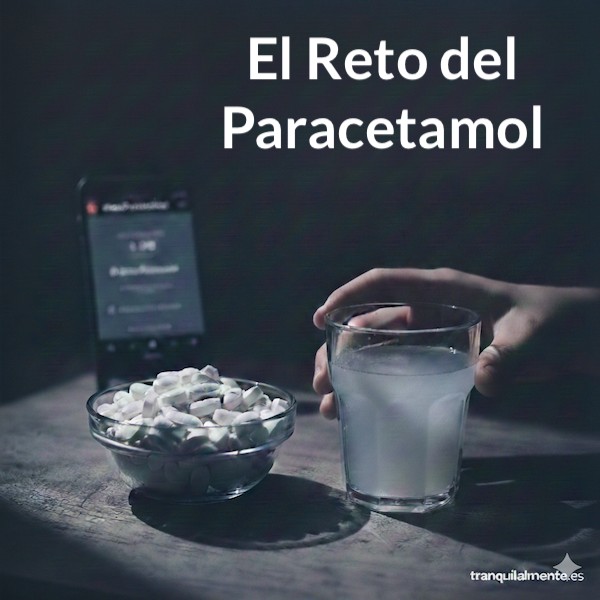
Paracetamol (acetaminophen) is one of the most widely used medications in the world. It is present in millions of homes and is perceived as a safe drug. And it is, when used correctly. However, its overdose can cause acute liver failure and even irreversible hepatic failure.
In recent months, the so-called "paracetamol challenge" has circulated on social media, which consists of ingesting large amounts to "see who can take the most."
The invisible danger: damage gives no warning
Paracetamol poisoning is especially dangerous because severe symptoms do not appear immediately. In the first few hours, the person may feel relatively well or present mild discomfort: nausea, malaise, some vomiting.
However, liver damage is already occurring.
Between 72 and 96 hours after ingestion, the most severe signs can appear:
- Jaundice (yellowing of the skin and eyes)
- Confusion
- Coagulation problems
- Acute liver failure
In the most severe cases, an urgent liver transplant may be necessary.
The antidote exists, but time is key
Treatment exists. The antidote is N-acetylcysteine (NAC), which works by neutralizing the toxic metabolite that damages the liver.
Its effectiveness is highest if administered within eight hours after ingestion. For this reason, given any suspicion of an overdose—even if the person feels well—it is imperative to go immediately to the emergency room.
Waiting for severe symptoms to appear can be too late.
Why would a teenager do something like this?
Most young people do not participate in viral challenges because they "want to die." Adolescence is a stage in which:
- Identity is under construction.
- Belonging to the group is central.
- The brain's reward system (dopamine) is highly active.
- The prefrontal cortex, responsible for impulse control and anticipating consequences, is still maturing.
The search for validation, peer pressure, and the immediate reward of "likes" and views can outweigh a risk that, moreover, is not perceived as immediate.
And here lies the trap: liver damage is not felt instantly. There is no clear signal acting as a brake.
Viral does not mean valuable
Digital platforms operate with algorithms designed to amplify what generates a reaction. The algorithm does not distinguish between valuable or harmful content; it distinguishes between what produces an impact and what does not.
When a challenge repeatedly appears on the "feed," it can give the impression that "everyone is doing it," even if that is not the case. Repetition normalizes.
That is why digital literacy is key: helping teenagers understand that virality responds to a market logic—attention equals money—and not necessarily to merit or prestige.
Simple questions can activate critical thinking:
- Would you do it if no one could record it?
- Does it bring anything real to your life or just momentary visibility?
Banning is not enough
The emergence of these challenges is not fought solely with bans. In fact, banning without an explanation can increase attraction.
Effective prevention is supported by several pillars:
- Emotional education.
- Digital literacy.
- Assertiveness skills to resist peer pressure.
- Clear and consistent rules on mobile phone use.
- A regulating, non-invasive adult presence.
But, above all, connection.
A teenager who feels heard, seen, and supported is less likely to look for their identity in dangerous, viral challenges.
What to do if we suspect risk
If we detect signs that a minor has thought about participating in a dangerous challenge, the initial reaction is decisive.
It is advisable to avoid panic and immediate reproach. Phrases like "How could you think of that?" or "You are disappointing me" usually close communication.
It is more useful to open a direct and calm conversation:
"I saw this and it worries me. Have you thought about doing it?"
Asking does not increase the risk. On the contrary: it reduces isolation.
An essential message
Teenagers do not seek to destroy themselves; they seek to belong, to experiment, to feel seen. The challenge is the means, not the end.
Prevention does not stem from fear or alarmist speech.
It stems from connection.
From an adult presence that listens without judging.
From safe spaces where each person can feel seen, recognized, and valuable without having to take risks to belong.
And in the specific case of paracetamol, the health message is clear: given any suspicion of an overdose, go immediately to the emergency room, even if "nothing seems to be happening." Because sometimes, when it seems like nothing is happening, the damage is already underway.